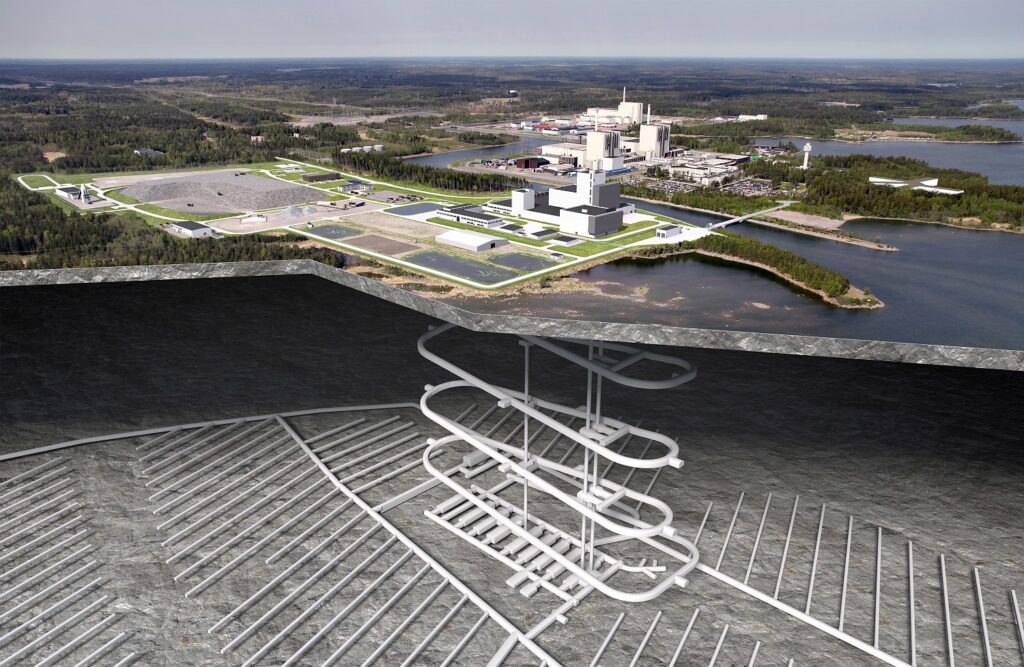
Conceptual design
Over a period of five decades, SKB has developed a conceptual design for nuclear waste management. It revolves around advanced solutions for the safe management and disposal of nuclear waste, focusing on environmental safety and long-term containment.
SKB has pioneered a multi-barrier system, the KBS-3 method, for the deep geological repository of spent nuclear fuel. This method involves encapsulating nuclear waste in corrosion-resistant copper canisters, surrounding them with bentonite clay, and disposing them at great depths in stable geological formations. SKB’s design emphasises sustainability, safety and minimising future human and environmental risks by isolating radioactive materials for hundreds of thousands of years.
SKB began its work with extensive research into geology, materials science and safety analyses to understand how to contain radioactive waste. This research led to the creation of the KBS-3 method, where various designs were conceptualised.
Licensed by the Government
After decades of research, development and testing, the method as well as the siting process to locate the spent fuel repository in Forsmark have been reviewed by the Environmental court in Sweden and by the Swedish Radiation Safety Authority, SSM. This resulted in a permissibility and license by the Government in January 2022.
The Environmental court set the conditions October 2024 and before SKB starts constructing the repository for spent nuclear fuel, an approved safety analysis report is required from the Swedish Radiation Safety Authority, SSM. This is part of the stepwise process and is anticipated to be settled in 2026.
A detailed repository design has been prepared, which includes constructing the repository and an encapsulation plant to encapsulate the spent nuclear fuel before disposal underground. The work includes preparing logistical frameworks, detailed construction planning, and establishing protocols for the eventual operation of the repository.
One of the world’s first
SKB’s process is notable for its thoroughness and emphasis on science-backed safety measures. It has set a global example by focusing on transparency, meticulous engineering standards, and robust environmental and safety analyses. With regulatory approvals in place, SKB is moving toward the construction and eventual operation of one of the world’s first fully operational deep geological repositories for spent nuclear fuel.
SKB’s Final Repository for Short-Lived Radioactive Waste, SFR, is located at Forsmark in the municipality of Östhammar. The facility started operating in 1988 and was then the first of its kind in the world.
SKB is extending the existing SFR to create space for low-level and intermediate-level decommissioning waste from the Swedish nuclear power plants. The decommissioning waste that contains radioactivity will be finally disposed of in SFR. This includes reactor components, scrap metal, concrete and other construction materials that have absorbed radioactive substances during the operating period.
Our offering:
- Support in developing a conceptual design
- Support in developing Engineering Barrier Systems, EBS
- Logistics and developing machinery for transportation and installation of canisters, buffer, backfill and other components
Last review: August 22, 2025
Last review: August 22, 2025